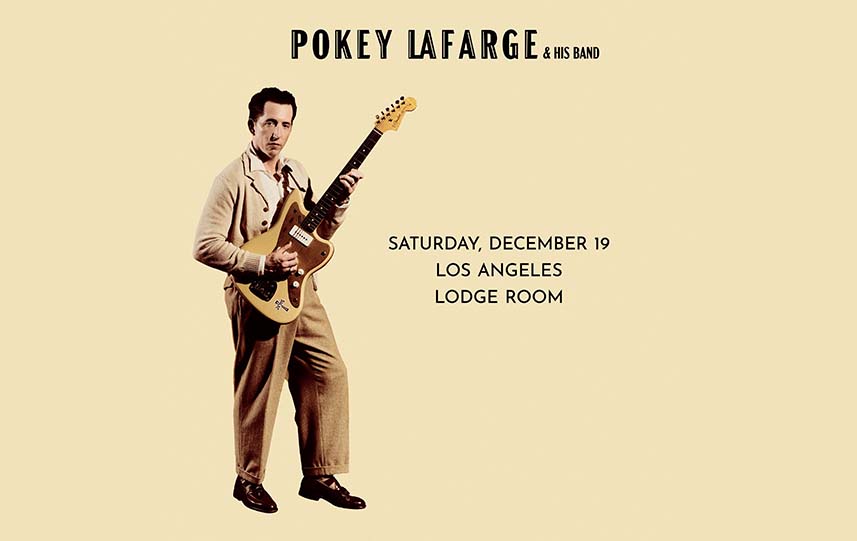
DOORS 7PM | SHOW 8PM
ALL AGES
For two decades, Pokey LaFarge has walked his own effortlessly cool road as an exceptionally iconoclastic troubadour – forthright, genuine, and markedly keen to put it all out there. Rent Money now sees the Illinois native pushing forward yet again with what can safely be declared his finest collection to date, both as a heartfelt expression of personal experience and as no-nonsense social commentary. With their twanging guitars, plucky rhythms, and undeniably captivating melodies, songs like the instant classic album opener, “The Thing,” and the tub-thumping title track see LaFarge surveying kitchen-table issues and inter-class discontent, as well as his own fears, frustrations, and uneasiness about the future. “My Baby Loves Me” and the stunning soul dancefloor-filler “Stick Together” soar and swing, their joyous refrains belying the inescapable undercurrent of constant worry and angst that permeates these troubled times.
“I certainly want to sing pretty songs,” LaFarge says. “But I’m not impervious to the issues that are happening today in the world. There was so much talk while I was writing this record, about the economy and how everything is more expensive today than it was yesterday. How kids barely know their parents, because both parents have to work two jobs. Just the absurdity of it all. It really does make you, I don’t want to say angry, but it makes you want to play music that’s a little bit tougher.”
As always, LaFarge deftly traverses genre boundaries, seamlessly integrating the myriad strains of 20th-century American music with a freewheeling command of earnest songcraft, inspired performance, and subversive creativity. 2024’s Rhumba Country blasted his sonic palette open with hints of island rhythms, highlife guitars, and more, maximizing those sounds by exploring them in his own unique fashion. Produced once again by Elliot Bergman (Wild Belle, LA LOM, Natalie Bergman), Rent Money now builds upon that record’s sweeping approach with an even wider panoply of influences, spanning – but limited to – urban blues, primal rock ‘n roll, early jazz, ragtime, first wave reggae, boogie, gospel and electric country funk, all brewed up into an irresistible honky-tonk of sound that somehow encompasses all the aforementioned styles but ultimately becomes something utterly original.
“Every record is a springboard into some new direction,” says LaFarge. “Maybe it’s going back, sometimes it’s going lateral, sometimes going exponentially forward. I’ve tried a lot of different stuff on the last few records. For me, this one was about sort of trimming the fat – super simple, less chords, less movement, just kind of getting back to my roots, just remembering where I came from and the music I started listening to when I first came up. I wanted to get back to some of the childlike simplicity I had when I first heard Chicago blues. Guys like Howlin’ Wolf and Chuck Berry changed my life.”
Working over a series of sessions at the producer’s “big, beautiful studio” in the rural woods just outside of Chicago, LaFarge and Bergman keep the arrangements crisp and uncluttered so that every nuance of instrument and voice can be clearly heard, utilizing the studio’s ample space, as well as a variety of vintage amps and equipment, to get a warm, cinematic, sound more expansive and resonant than on any of his previous work. Much of the album was crafted in spontaneous first takes, with LaFarge laying down basic grooves and licks which were then embellished and augmented by the multi-talented Bergman and an assortment of trusted band members, with extra color courtesy of backing vocals from his wife and frequent co-writer – Addie Hamilton, and Bergman’s sister, acclaimed singer-songwriter Natalie Bergman.
“I don’t know much about studio stuff,” LaFarge says. “I just know what I want the song to sound like. I’m always just thinking about the song and the performance, and then hopefully the people that are in the studio with me can make it work. That’s why finding the right producer matters, somebody who really is going to let you be yourself, not try to project. I’ve had that in the past – sometimes it worked and really pushed boundaries for me and helped me kind of till some new soil, and other times it’s been kind of a square peg in a round hole-type situation. It just hasn’t worked out. You take some chances, and you make some mistakes. But in this case, Elliot definitely knows who I am for the most part and is able to kind of heighten that in the studio.”
Though in many ways LaFarge’s most explicit record as far as conveying his social conscience, Rent Money doesn’t lay blame or point fingers. The only side LaFarge chooses to take in this unceasingly divided era is that of the common man, opting not to declare either himself red or blue by speaking to values and experiences that are – or at least should be – universal. LaFarge believes his purpose as an artist is not to get between factions with different beliefs, but to heal the wounds between them with the righteous power of rock ‘n’ roll, however one defines that all-encompassing music.
“My perspective with most things, whether they be social issues, maybe quasi-political issues, I very rarely choose to be overt,” LaFarge says. “That’s the antithesis of poetry for me. I would rather be a little bit more subversive and, like the artist MC Escher, create a different perspective. Planting seeds and saying things in a different way that hopefully allows people to look at things from a different light.”
Despite their exuberant spirit, songs like “Work” and “Big Boss Man” – not the Jimmy Reed standard but a self-penned new original – survey how hard work in hard times doesn’t always pay the bills, both in terms of practicality and spiritual sustenance. LaFarge artfully avoids direct polemic to better explore the effects of politics on living, breathing people, giving his songs a pragmatic power to strike a universal chord in a divided audience that, in its heart, still yearns for community and connection.