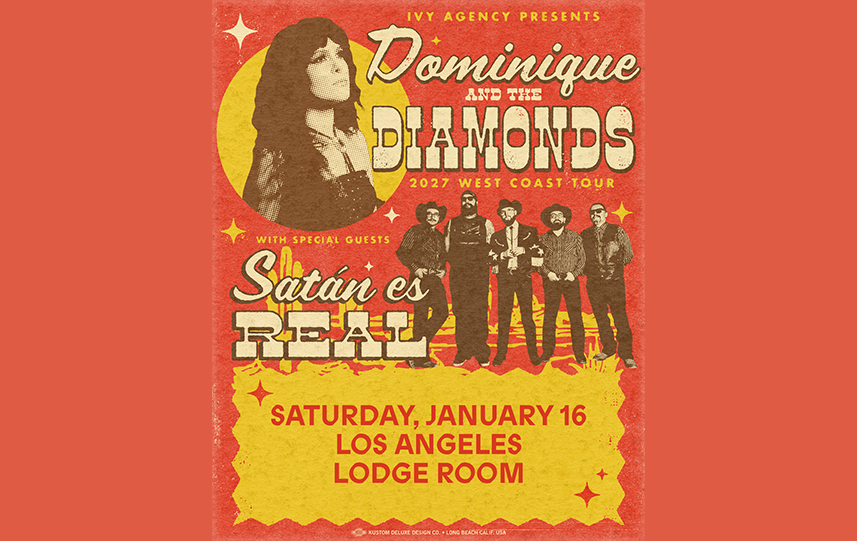
DOORS 7PM | SHOW 8PM
ALL AGES
Dominique and the Diamonds arrive with a timeless confidence that belies their brief tenure—a northeast Los Angeles outfit led by Colombian‑American singer‑songwriter Dominique Gomez, whose voice anchors a California country‑rock sound that feels both cosmic and classic. Their new album, Honky Tonk Queen, summons the spirit of the long-lost 1970s Sunset Strip and Laurel Canyon era, weaving sun‑baked desert noir with coastal cowgirl romance into a record that’s as reverent as it is revelatory. The record stitches vintage country storytelling to shimmering, reverb‑kissed pedal steel guitars and harmonies that recall the warmth of golden era West Coast recordings. Throughout, Gomez’s voice is the album’s lodestar—often likened to Linda Ronstadt for its nostalgic clarity and emotional directness—possessing power, grit, and an honesty that stops a room. It’s the kind of voice that makes listeners forget their plans and lean in, seeking the next line. Though Dominique and the Diamonds have only been active on the scene for a year, they’ve quickly captured the attention of fans and critics alike. Their sound draws openly from classic acts—the Flying Burrito Brothers, The Rolling Stones, Neil Young, Townes Van Zandt—yet Honky Tonk Queen never feels imitative; it reinterprets those influences through a distinctly contemporary lens, where cosmic textures meet down‑to‑earth storytelling.
Satán Es Real
Originally from Mexicali, Mexico, just across the border from the southern United States, Satan es Real
emerged as a project incubated during the pandemic, shaped by the many musical influences of
Alejandro Ruiz. Coming from a background rooted in metal and punk, songs inspired by traditional
American music slowly began to take form, navigating through Country, Bluegrass, Rock n’ Roll, and
beyond. Influenced by artists such as Hank Williams, Twin Temple, King Dude, Orville Peck, and Charley
Crockett, Satan es Real began carving its own path with what they call their Gothic Country from the
Cursed West.
In early 2021, Alejandro Ruiz started writing songs deeply connected to the western essence of the
desert he comes from, while embracing his own musical roots in bands like Slayer, Venom, and
Midnight. Little by little, a distinctive sound and songwriting identity started to develop alongside fellow
musicians such as Jorge Soto, the band’s first trumpet and banjo player, while new members and
instruments were gradually incorporated into the project.
Following their debut in 2022, Satan es Real quickly established itself as one of the standout bands in
their hometown, leading to collaborations with Mexican artists such as Juan Cirerol and Damaris Bojor.
This momentum pushed the band to perform throughout different regions of Mexico. Their proximity to
the border, along with the dual-nationality background of its members, also helped create a close
connection with California border towns and cities such as El Centro, Jacumba, and Los Angeles, opening
the door to collaborate on multiple tours supporting Jenny Don’t and The Spurs.
With a live session available across digital platforms, seven singles, and a five-song EP, Satan es Real
continues to showcase its versatility by blending genres through its own influences and creative
landscapes.
Satan es Real seeks to open a new path for country music in Spanish from the northern border of
Mexico.
De Mexicali, Mexico justo en la frontera al sur de Estados Unidos nace Satan es Real. Un proyecto incubado durante la pandemia que tomo forma de las múltiples influencias de Alejandro Ruiz para componer música. Llegando de la escuela del metal y el punk se empiezan a sembrar canciones con raíces en la música tradicional de Estados Unidos navegando en Country, Bluegrass, Rock n Roll, entre otros. Influenciado por artistas como Hank Williams, Twin Temple, King Dude, Orville Peck, Charley Crockett es que comienza a construirse el camino de Satan es Real y su Country Gotico del Oeste Maldito.
A inicios del 2021 Alejandro Ruiz empezó a crear canciones con esencia western, del desierto de donde proviene abrazando sus propias raíces musicales (Slayer, Venom, Midnight). Poco a poco es que se gestando un sonido propio y una manera de composición propia de la mano de colegas músicos como Jorge Soto, quien fue el primer trompetista y banjista de la banda. Y adaptando a nuevos integrantes e instrumentos a la banda.
Tras su debut en 2022 lograron posicionarse como una banda referente en su ciudad, y así llegaron colaborar con artistas nacionales como Juan Cirerol o Damaris Bojor. Lo cual los ha impulsado a viajar al interior del país. Su cercanía con la frontera y la nacionalidad de sus integrantes lograron establecer una íntima relación con ciudades cercanas a la frontera en California como El Centro, Jacumba, Los Angeles. Dando la oportunidad de colaborar en diferentes tours con Jenny Dont and The Spurs siendo su banda de soporte.
Con un live sesión en plaformas, siete sencillos y un EP de 5 canciones muestras su versatilidad para componer y mezclar géneros con sus influencias y contextos creativos.
Satan es Real busca abrir camino para una nueva interpretación del country en español desde la frontera norte de México.