Fri,
Mar 6
LODGE ROOM PRESENTS
DOORS 7PM | SHOW 8PM
ALL AGES
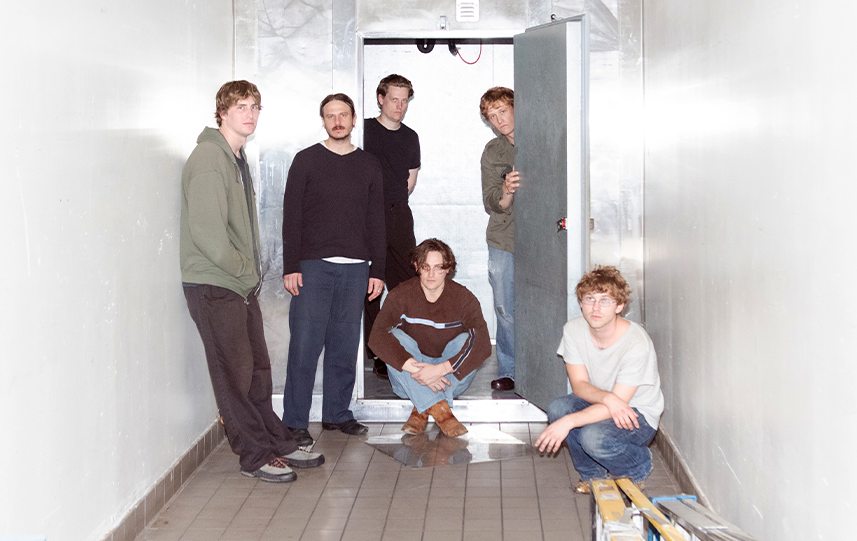
Dutch Interior
When Jack Nugent, Connor Reeves, Shane & Hayden Barton, Davis Stewart, and Noah Kurtz started making music together as Dutch Interior, the lifelong friends living between houses in Los Angeles and Long Beach had been in and out of each other’s lives for the better part of two decades. The best relationships come easy, and the band is the product of a creative union brought on by already-established trust and familiar insularity. Beginning as a fluid experiment of songs born in the moment, initial recordings Kindergarten and Blinded By Fame trace an uncanny and distinctive world of their own design. You can begin to pick up the separate stylings and personalities of the band members by the songs they independently write before bringing to the band at large, where the tracks often grow into new forms all together. Despite this individual approach to songwriting, they describe each other as “branches of the same core life” whose colliding influences and experience all bleed into the songs.
Describing Sandcastle Molds as a “fucked up Fleetwood Mac song,” Nugent elucidates that “this song grew from the realization, while driving down the 405 after a long night, that I might be losing my edge. Sandcastle Molds deals with holding on to your sense of self as the world descends into madness at a nauseating pace. How does one hold on to hope when the state of all things seems to be in rapid decay?” The band’s music has always been filled with both introspective yearning and outsized emotion and ambition, and the new single refines the band’s genre-less rock music with an undercurrent of compelling melody.
All of Dutch Interior are internalized romantics, enraptured with fragmented moments that appear almost slapdash in their lyrics as well as the naive belief in human connection as the only way to save ourselves. It’s this stark romanticism that makes the music of the band expand outside the confines of the spaces they dwell into something more universally compelling, a manifestation of hope and faith that, together, they can create something bigger than themselves. With influences spanning from ambient to southern rock to jazz to dance music, the band shapeshifts and oscillates between alternative country, sharply hewn indie rock and hints of dissonant ambience, all while still sounding like a band who both speak their own private language and translate it into something universal.
North Americans
Long Cool World, the fifth LP from Los Angeles-based musician Patrick McDermott’s North Americans project, begins with a plaintive strum, before Portland, Oregon-based Barry Walker chimes in with an expansive, melancholy arc of pedal steel. It is a moment that seems both wide open and completely intimate, gesturing at the hugeness of the natural world, while also taking comfort in the small moments.
As North Americans, McDermott has been experimenting with drone and noise and how it can take shape, and then jettison that shape, since 2013’s No_No, but it’s when he embraced his love of fingerpicked guitar and vintage country music on 2018’s Going Steady that he settled on a sound that felt like a genuine melding of his disparate musical interests. 2020’s Roped In was another creative milestone: with Walker and a host of other collaborators, including harpist Mary Lattimore, and guitarist William Tyler creating a communal, layered approach to each track that felt vital as the world dipped into isolation during a global pandemic. “I knew that for this one I wanted to dial up some of the textures and experimentation,” McDermott says.
In order to do that, Long Cool World, strips away most of the musical collaborators, allowing Walker and McDermott to settle on an approach that is at once intricate and simple, creating hypnotic music that loops and layers, with subtle shimmers of noise or quiet psychedelic freakouts hiding beneath McDermott’s unshowy but emotionally affecting guitarwork and Walker’s pedal steel hum. The duo refined their collaborative relationship as well, with McDermott sending isolated guitar tracks to Walker, who then listened to them while on drives and walks around Portland, before going into the studio with only a loose sense of what he wanted to add to them. Eventually McDermott and Walker came together to record the album, giving the whole thing a sort of free-flowing, naturally collaborative feel. “We were really excited to dig into our own process in a more focused way together,” McDermott says. Walker echoes this sentiment, speaking of how those guitar loops built into a full-fledged collaborative relationship: “There were times when we played the organ together,” Walker says, speaking of the tandem organ drone of “The Last Rockabilly.” “We sat down and it was feeding through the Leslie speakers and we were doing a drone together–it was a lot of instinct.”
At its core, Long Cool World is a confident album that finds its heart in deceptively simple moments: the pedal steel cascading over McDermott’s strumming on “Think of Me as a Place” or the quiet burst of noise at the midpoint of first single “Classic Water,” or the warm, drunk wobble of album closer “Bad Box,” are all moments that happily exist on the periphery of the core sound of the record, but take center stage the more you listen. “This music is so simple. I just didn’t feel like I needed more, where my instinct previously was to add more whenever it was applicable,” McDermott says.
Though you may hear plenty of clear influences here—Long Cool World does exist firmly in the American Primitive tradition, after all—there are a few that exist just under the radar, but offer up fascinating context to not just the album’s roots, but how McDermott and Walker think about composition in general: guitar loops repeat until they become abstractions of themselves, drawing inspiration from McDermott’s love of DC hypnotic hardcore experimentalists Lungfish and the delicate compositions of Loren Connors circa Airs. Walker, for his part, draws inspiration from older sounds—Michael Hurley’s deceptively simple guitarwork, Washington Phillips’ zither, the “polyphonic harmonies of the Bosavi and Mbuti people,” and much more. “I draw inspiration from old forms,” Walker says. “Ancient melodies that have tumbled and been rounded in the waters of oral tradition, settled into folk and classical music, and then eroded again.”
This erosion, followed by a sort of contextual rebuilding, is a central theme found in not just the music on Long Cool World, but the North Americans project as a whole. As if Walker and McDermott are perpetually seeking to answer the questions: what happens when we create and collaborate instinctually? And how do we channel the unpredictability of influence into a cohesive song cycle that seeks not to portray a single moment or memory, but instead a state of being that is exactly as natural as the world it was borne from? Long Cool World doesn’t so much answer those questions as it does sit with them, comfortable in the wild beauty of modern life.